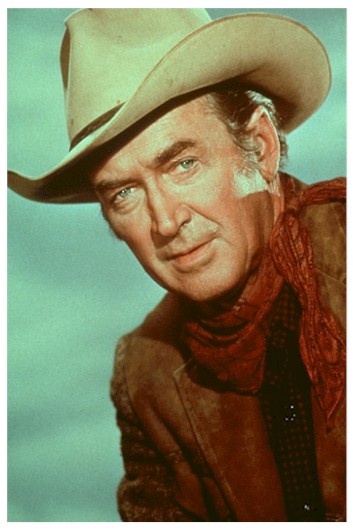
The Six Shooter. November 1, 1953. Program #7. NBC net. “Ben Scofield”.
“Britt forces the sheriff to go after a robber, even though the wounded crook may be the sheriff’s son. Jimmy Stewart, Jack Johnstone (director), Basil Adlam (music), Parley Baer, Herb Vigran, William Conrad, Frank Burt (writer, creator), Bert Holland, Hal Gibney (announcer).“
The Six Shooter. October 25, 1953. Program #6. NBC net. “Red Lawson’s Revenge”.
“Red Lawson has announced that he’s going to kill Britt’s friend Dan to get revenge for the death of his brother, four years previously. Frank Burt (creator), Les Crutchfield (writer), Shirley Mitchell, Barney Phillips, Hal Gibney (announcer), Jimmy Stewart, Basil Adlam (music), Leone LeDoux, Paul Richards, Hal Gibney (announcer).”
The Six Shooter. October 18, 1953. Program #5. NBC net. “Rink Larkin”.
“Eleven year old Rink Larkin learns that the sheriff has killed his father and is determined to get his revenge on the lawman. Jimmy Stewart, Sammy Ogg, Frank Burt (writer, creator), Russell Thorson, Basil Adlam (music), Hal Gibney (announcer), Tony Barrett, Jack Johnstone (director).“
James StewartThe Six Shooter – Episode 04 “Silver Annie”
The Six Shooter. October 11, 1953. Program #4. NBC net. “Silver Annie”. Sponsored by: Coleman Home Heating.
“Silver Annie Huxley refuses to sell her silver mine to the railroad, to the distress of the rest of the town of “Virtue City.” Jimmy Stewart, Dan O’Herlihy,, Robert Griffin, Parley Baer, Frank Burt (creator, writer), Hal Gibney (announcer), Jeanette Nolan, Herb Vigran, Basil Adlam (music), Jack Johnstone (director).”
The Six Shooter. October 4, 1953. Program #3, NBC net. “The Stampede”. Sponsored by: Coleman Home Heaters.
“Britt Ponset finds himself on a cattle drive with two feuding brothers. Jimmy Stewart, Lou Merrill, James McCallion, Frank Burt (creator, writer), Jack Johnstone (director), Basil Adlam (music), Hal Gibney (announcer).“
The tragic part of living a life of “quiet desperation” (in the Henry David Thoreau sense) is usually the lost opportunity to do good as opposed to “intentional malice.”
For sweetest things turn sourest by their deeds; Lilies that fester smell far worse than weeds.
Sonnet 94 (William Shakespeare)
In 2023 Merriam-Webster tells us that a “tragedy” is “a disastrous event : CALAMITY”
Back in Mr Shakespeare’s time a “tragedy” was closer to “a medieval narrative poem or tale typically describing the downfall of a great man” (Merriam-Webster definition 2C – and I used the term as in Merriam-Webster definition 3: “tragic quality or element”)
fwiw: Mr Shakespeare’s plays tend to be divided into “tragedy”, “comedy”, and “histories” – kind of the broad “genres” of his time. In Shakespearean “tragedy” a lot of people will be dead at the end of the play, in a “comedy” folks will pair up/get married, and “histories” were obviously “based on a true story” BUT tended to be presented to “please the sponsor” much more than be an accurate representation of historic events …
Sisyphus
The Ancient Greek concept of tragedy would have required a “great man” – to suffer a great downfall BUT more along the Merriam-Webster 2A definition (“the a serious drama typically describing a conflict between the protagonist and a superior force (such as destiny) and having a sorrowful or disastrous conclusion that elicits pity or terror”)
Ancient Greek “tragedy” tends to involve a “mostly admirable” king/leader that does nothing “wrong” but still suffers because of a relatively small character flaw – e.g. the hero tries to avoid his “destiny”/fate and ends up bringing about his fate BECAUSE he tried to avoid it.
Wikipedia tells us that Sisyphuswas the king of Corinth, punished in Tartarus by being cursed to roll a huge boulder up a hill in Greek mythology.
BUT the myth of Sisyphus is more of a “cautionary tale” about divine justice rather than a “tragedy” – the “lesson” the Ancient Greeks were passing along with the myth of Sisyphus was probably “don’t mess with the ‘gods’” not “don’t fight your fate”
The punishment aspect of the myth of Sisyphus is always that he is sentenced to an endless AND pointless task – just pushing the boulder up a hill might not seem that bad, but being forced to do it FOREVER for no reason, well, that wouldn’t be any fun … The Ancient Greek concept of tragedy would have required a “great man” – to suffer a great downfall BUT more along the Merriam-Webster 2A definition (“the a serious drama typically describing a conflict between the protagonist and a superior force (such as destiny) and having a sorrowful or disastrous conclusion that elicits pity or terror”)
Ancient Greek “tragedy” tends to involve a “mostly admirable” king/leader that does nothing “wrong” but still suffers because of a relatively small character flaw – e.g. the hero tries to avoid his “destiny”/fate and ends up bringing about his fate BECAUSE he tried to avoid it.
Wikipedia tells us that Sisyphuswas the king of Corinth, punished in Tartarus by being cursed to roll a huge boulder up a hill in Greek mythology.
BUT the myth of Sisyphus is more of a “cautionary tale” about divine justice rather than a “tragedy” – the “lesson” the Ancient Greeks were passing along with the myth of Sisyphus was probably “don’t mess with the ‘gods’” not “don’t fight your fate”
The punishment aspect of the myth of Sisyphus is always that he is sentenced to an endless AND pointless task – just pushing the boulder up a hill might not seem that bad, but being forced to do it FOREVER for no reason, well, that wouldn’t be any fun …
Lloyd Dobler
Now, the “average Ancient Greek” was a subsistence farmer (well, the “average Ancient human” was also a subsistence farmer – but that isn’t important).
Life as a “subsistence farmer” (i.e. trying to live off of growing your own food) probably sounds “hard” to modern humans – but it would have had the advantage of a clear purpose/reason for daily labor (i.e. “survival” – feed yourself and your family).
Fast forward to the 20th Century and there are still subsistence farmers – but they tend to be in what gets called “developing nations” in 2023.
(aside: The concept of “Third World” nations is a relic of the “Cold War” – i.e. countries could be divided into “us” vs “them” with “not us or them” being the “Third World” – of course those countries were probably NOT “us” OR “them” because they were “undeveloped” – but now I feel like I’m going in circles.)
Just like in “ancient times” the average “modern” subsistence farmer is most concerned with survival – and that daily struggle for survival is an obvious “purpose for work.”
In the “developed world” the “people” can still be divided between “haves” and “have nots” – but the daily struggle for “food” has been replaced by a “subsistence paycheck” in exchange for labor.
Of course the “problem” for “modern workers” can become CHOOSING a profession — i.e. again, for most of human existence the problem was growing enough food to survive – not “self-fulfillment”
The last half of the 20th Century saw a lot of “progress” but human nature didn’t change. We “know” more and we “have” more in the “developed world” but humans are still the same “stuff” we have always been.
Better nutrition and health care means the average height and weight have increased – people are bigger and healthier but still the same ol’ “people.”
The unintended consequence of material prosperity has been to replace the “fight for survival” with a “search for meaning.”
A lot of folks have ALWAYS managed to avoid the subject – and these are those folks leading the “unexamined life is not worth living” (as Socrates put it) or “lives of quiet desperation” (as Mr Thoreau put it).
The late 20th century version of that struggle is found in “Say Anything” (1989) when the protagonist points out:
“I don’t want to sell anything, buy anything, or process anything as a career. I don’t want to sell anything bought or processed, or buy anything sold or processed, or process anything sold, bought, or processed, or repair anything sold, bought, or processed.”
–Lloyd Dobler
The Seeker
From a “big picture history” point of view the rise and fall of “great societies”/Empires can be seen as a failure of “values.”
Yes, different cultures have different concepts of “normal” – BUT for them to be a “culture” they have a “set of shared attitudes, values, goals, and practices.”
It should be obvious that just living in the same geographic region does NOT make a “culture” – unless you count hating ‘those people’ as a “culture”
I won’t bother with multiple examples – e.g. “Arabs” and “Jews.”
On a MUCH smaller scale I laughed at myself when I didn’t apply for a “tech job” with a school system in southwestern Ohio because THEY were rivals with US in high school sports (ok, there were other reasons as well – but the friendly sports rivalry was my first thought when I saw the job posting).
“The Who” (one of those “rock & roll” bands) serves as a modern cultural example of that human “desire for meaning” and “belonging” – one of their songs asks the big question but American poet E.E. Cummings asked a similar question in 1923:
seeker of truth
follow no path all paths lead where
truth is here
e.e. cummings
The obvious problem for “seekers” is that it is possible to be deceived into thinking “truth is here” when it isn’t – this verse comes to mind –
I tend to be suspicious of ANYONE that asks me to “trust them” about ANYTHING without any proof/verification – but that is just me (Luke 6:43-45 also comes to mind)
Just because someone believes something and is sincere DOES NOT mean they are “true” – it is possible to be “sincerely wrong” …
of course I could ALWAYS be wrong so you shouldn’t trust me on that –
The Six Shooter. September 27, 1953. Program #2. NBC net. “The Coward”. Sponsored by: Coleman Home Heaters.
“Everyone knows that Will Fedder is a coward because he won’t wear a gun. However, a man can be pushed just so far! Jimmy Stewart, Howard McNear, Michael Ann Barrett, Will Wright, Frank Burt (creator, writer), Basil Adlam (music), Jack Johnstone (director), Hal Gibney (announcer), Herb Ellis.“
Originally broadcast September 20, 1953 – this recording is from the “Old Time Radio Researchers Group” – I “cleaned up” the audio a little
The Six Shooter – Episode 01: “Jenny”
The Six Shooter. September 20, 1953. Program #1. NBC net. “Jenny”. Sponsored by: Coleman Home Heaters.
“Britt Ponset finds a wounded man in the desert and brings him to Jenny Garber to nurse him back to health. No man seems to think much of Jenny. A moving, well-written story. Jimmy Stewart, Frank Burt (creator, writer), D. J. Thompson, Harry Bartell, Jack Johnstone (director), Hal Gibney (announcer), Basil Adlam (music), Jess Kirkpatrick, George Neise.”
Starting with a definition: Communication is “a process by which information is exchanged between individuals through a common system of symbols, signs, or behavior” (thank you Merriam-Webster — emphasis mine)
Notice the emphasis on “information is exchanged.” If INFORMATION is NOT being EXCHANGED then you don’t have “communication.” Two people yelling at each other might be “fighting” and “sending messages” but calling a screamed insult “information” is true only at the lowest level.
Remember “communication” involves a “message” being “sent” AND “received” — e.g. if both sides are “sending” at the same time (e.g. two folks yelling at each other) then accurate reception of the “sent” message is unlikely.
My completely made up on the fly “communication rule #1” is to point out that “active listening” is part of “effective communication.”
Know the audience
Imagine a radio station BROADCASTING a signal. That “signal” has to be “received”/interpreted for “communication” to take place.
If a “sender” wants their message to be understood – then they need to tailor the “message” to the recipients. That radio station is sending out a signal on a specific frequency which recipients will need a “radio receiver” tuned to the correct frequency to receive.
BUT the “message” also need to be crafted with the recipients in mind. e.g. someone is giving a speech to “college presidents” the form of the message will be much different than someone giving a speech to “elementary school students.”
The “message” will also need to be adjusted based on the “media” involved — e.g. a “published article” in a scholarly journal will be crafted differently than an op-ed for a local newspaper.
What should be “obvious” is that NOTHING should be assumed to be “obvious.” The more familiar a “speaker”/”writer” is with their audience the better they will be able to communicate a message.
e.g. Assuming that “EVERYONE knows” something can cause problems – “Well, everyone knew I was joking” becomes a recipe for misunderstanding (especially if you are in a leadership position)
btw: I’m NOT saying to avoid “humor” – I’m pointing out that attempts at “humor” can easily be misunderstood. “Joking around” with people you have known for years will (almost certainly) be taken differently than “joking around” with someone you just met …
Feedback
Definition time: Feedback “the transmission of evaluative or corrective information about an action, event, or process to the original or controlling source”
“Feedback” covers a LOT of communication territory – it can be positive or negative – constructive or destructive – and will obviously vary in “usefulness” based on a combination of “sender” AND “receiver” characteristics.
Effective feedback takes effort and a willingness to listen. Honesty is essential – BUT “honesty” should not be an excuse to be mean/insulting.
“Honest” feedback is NOT just pointing out everything someone did WRONG. Honestly pointing out the positives is also not “flattery.”
Feedback is (drum roll) “communication” – and to be effective must be tailored to the individual/audience AND be “actionable.”
A “fan” telling their favorite artist how fantastic they (the artist) is might be “honest” and appreciated – but isn’t exactly “useful feedback” – e.g. Fan: “YOU are great I love your work” Artist: “Thank you”
Same is true of a “manager” heaping abuse on an “employee” during an “annual review” – e.g. manager: “I haven’t given you any feedback all year, but now I am going to tell you how terrible a job you have done so I can justify not giving you a raise!” Employee: “Thank you for the motivation to look for another job!”
The “actionable” part if important for something to be “feedback” – i.e. if I just say “I liked x and y” then I am giving my opinion – If I say “X and Y seemed to work well, Z could have been better – maybe try ABC next time” then THAT is “feedback”
Praise
A specific type of feedback gets called “praise.” By definition praise is favorable BUT it is not just giving compliments or saying “positive” things.
For “praise” to be effective it needs to be specific. e.g. “I watched your performance and I thought you did x, y, and z REALLY well” is better than “You looked good out there” (though both may be appropriate at certain times).
Compliments also work best when they are specific – with “honesty” being the difference between a “compliment” and “flattery.”
When “awards” show season rolls around I tend to point out that giving out awards for singing/acting/artistic impression is a little pointless from a “fan” point of view (i.e. I don’t need someone to tell me what I should like) BUT that doesn’t mean the awards are pointless.
Hey, fans “voted” on what they like by buying tickets – so a lot of awards become “recognition by peers.” e.g. If “people that do X” for a living all get together and vote on who did “X” best this year – and then give out an award – the award becomes a form of “peer praise”/recognition, which is always nice
The point being that “knowledgeable praise” – as in “praise from people that honestly understand the act being praised” – is much more valued than “random praise from non-experts”
Constructive Criticism
Of course “perfect performances” tend to be rare – so pointing out “what didn’t go so well” is also important.
“Criticism” implies “unfavorable feedback” – which is why you often hear the term “constructive criticism” used for the process of “evaluating or analyzing” an event.
“Youth coaches” will talk about “praise sandwiches” as a model for constructive criticism – e.g. start the feedback with a “positive” (praise), mention a “corrective” (criticism), and then end with another “positive” (praise)
Once again, audience matters – if you are coaching a “Little League Baseball” team and are talking to the team after a game, then “praise sandwiches” all around. If you are doing film study with older athletes then “praise sandwiches” will probably come across as a little disingenuous.
The Pet Peeve
Occasionally I see a “social media” post that goes something like “I don’t know who needs to hear this – but you are doing a great job!”
“You can do it!”
Townie (Rob Schneider) from “The Waterboy“
Now, I appreciate the sentiment – but generic affirmations from someone that has never met me are not particularly useful.
I’m not particularly offended by those type of posts – but I wouldn’t classify them as “feedback” in any form. Maybe call them a “positive thought broadcast” but not “praise.”
Originally broadcast July 15, 1953 – this recording is from the “Old Time Radio Researchers Group” – I “cleaned up” the audio a little
“The Six Shooter. July 15, 1953. An audition program. Britt forces the sheriff to go after a robber, even though the wounded crook may be the sheriff’s son. Jimmy Stewart, William Conrad, Parley Baer. 23:56.”